

Key Takeaways
- The most fragile point in Atlanta dual diagnosis care is the discharge window after detox, where Medicaid enrollment delays and split state agencies shrink real referral options 13.
- DBHDD uses ‘dual diagnosis’ to mean mental illness plus IDD, so name specific co-occurring diagnoses on referrals to avoid misrouting MH+SUD patients 2.
- Route Medicaid and uninsured patients through GCAL at 800-715-4225 for community behavioral health intake, and reserve 988 for active crisis stabilization 12, 3.
- Before referring, verify concurrent treatment plans, cross-trained clinicians, stage-wise care, dual recovery groups, monitored pharmacotherapy, and 30/60/90-day engagement rates to separate integration from co-location 9.
The handoff window: where dual diagnosis care in Atlanta usually breaks
You already know the pattern. A patient stabilizes over five to seven days of medical detox, engagement is finally possible, and then the calendar runs out. The bed is needed. The next appointment is three weeks away. The psychiatric intake at one program, the SUD counseling at another. By the time either door opens, the person you spent a week reaching is unreachable again.
That gap between acute stabilization and sustained counseling is the single most fragile point in dual diagnosis care, and in metro Atlanta it has a specific shape. Georgia’s Medicaid enrollment process for behavioral health providers can run two to nine months from application to approval 13, which quietly shrinks the network of counseling programs actually available to a patient on the day of discharge. Add the state’s split administration between DCH and DBHDD, plus Care Management Organization routing 12, and a warm handoff turns into a scheduling problem with three phone trees.
This piece is written for you as a peer working that window: LPCs, LCSWs, psychiatric NPs, discharge planners, hospital social workers, peer navigators. The goal is not another primer on co-occurring disorders. It is a working map of how integrated counseling should function in a session, how Georgia’s access architecture actually routes people, and what to check before you send a patient anywhere. The handoff is engineerable. You just have to see the whole system at once.
The Georgia terminology trap that misroutes referrals
Here is a small vocabulary problem that causes real routing errors. When you say “dual diagnosis” in a clinical huddle at a detox unit, you almost certainly mean co-occurring mental illness and substance use disorder. When the Georgia Department of Behavioral Health and Developmental Disabilities uses the same phrase on its public pages, it means something different: co-occurring mental illness and an intellectual or developmental disability 2. DBHDD’s Dual Diagnosis Services list and its guiding Policy 04-110 sit inside that IDD-focused frame 1.
So when a discharge planner searches DBHDD’s site for “dual diagnosis services” hoping to find MH+SUD counseling for a patient leaving detox, the results describe a different service line entirely. The referral goes to a program built for a different population, or the planner assumes the state offers nothing and stops looking. Neither outcome is what your patient needs.
A quick way to hold both meanings in your head:
- DBHDD dual diagnosis = mental illness + intellectual/developmental disability, routed through the Georgia Access Point 2.
- Clinical dual diagnosis (what you probably mean) = mental illness + SUD, routed through community behavioral health providers reached via the Georgia Crisis and Access Line at 800-715-4225 12.
When you write referrals, name the co-occurring conditions specifically rather than relying on “dual diagnosis” as shorthand. Write “co-occurring MDD and alcohol use disorder” or “PTSD with opioid use disorder.” It takes five extra seconds and it keeps intake staff from misclassifying your patient into a service line built for someone else. The terminology gap is not your fault, but working around it is a small, concrete thing you can control.
What integrated counseling actually looks like in a session
Peers vetting a program need something more concrete than “we do integrated care.” Every intake coordinator will say that. The question is whether the actual session structure holds up.
SAMHSA’s issue brief on co-occurring disorders lays out the components that separate a truly integrated program from a co-located one:
- concurrent treatment of both conditions
- cross-trained clinicians
- stage-wise care matched to the patient’s readiness
- motivational techniques
- addiction counseling delivered alongside mental health treatment
- multiple formats of care
- monitored pharmacotherapy 9
Read that list slowly. Each item is a design choice you can verify by asking specific questions.
Concurrent treatment means the depression and the alcohol use disorder are on the same treatment plan, worked on in the same session by clinicians who can move between them without a handoff. If a program tells you the SUD counselor sees your patient Tuesday and the psychiatric NP sees them Friday and they “coordinate,” that is co-located care with a shared parking lot. It is not what the evidence supports.
Stage-wise care matters because a patient two weeks out of detox is not in the same place as one at nine months. SAMHSA’s implementation guide starts program planning with evaluating pressing needs and determining the consumer’s stage of treatment before selecting target behaviors 7. In a session, that looks like a clinician who does not push a relapse prevention worksheet on someone still in engagement stage, and who does not run motivational interviewing loops with a patient ready for active skills work.
Cross-trained clinicians is the piece most programs fudge. Ask directly: what percentage of your counselors hold both an addiction credential and mental health licensure, and how do you handle a session where PTSD symptoms and cravings are both live in the room? A program with a real answer will describe functional analysis, coping skills training, and integrated CBT approaches like relapse prevention therapy that address both symptom clusters in one conversation 10.
Monitored pharmacotherapy closes the loop. Someone is tracking whether the SSRI, the naltrexone or buprenorphine, and any as-needed medications are working together, not against each other. For your patient walking out of detox on new medications, that oversight is the difference between a stable first month and a preventable ER visit.
One honest note: the model itself is well-established. SAMHSA and the field’s Treatment Improvement Protocol chapter both describe integrated care as best practice for co-occurring disorders, while acknowledging that programs vary widely in how deeply they implement each component 8. Your job is not to find perfection. It is to know which components are non-negotiable for your specific patient and to ask about them by name.
Why integrated counseling still isn’t the default
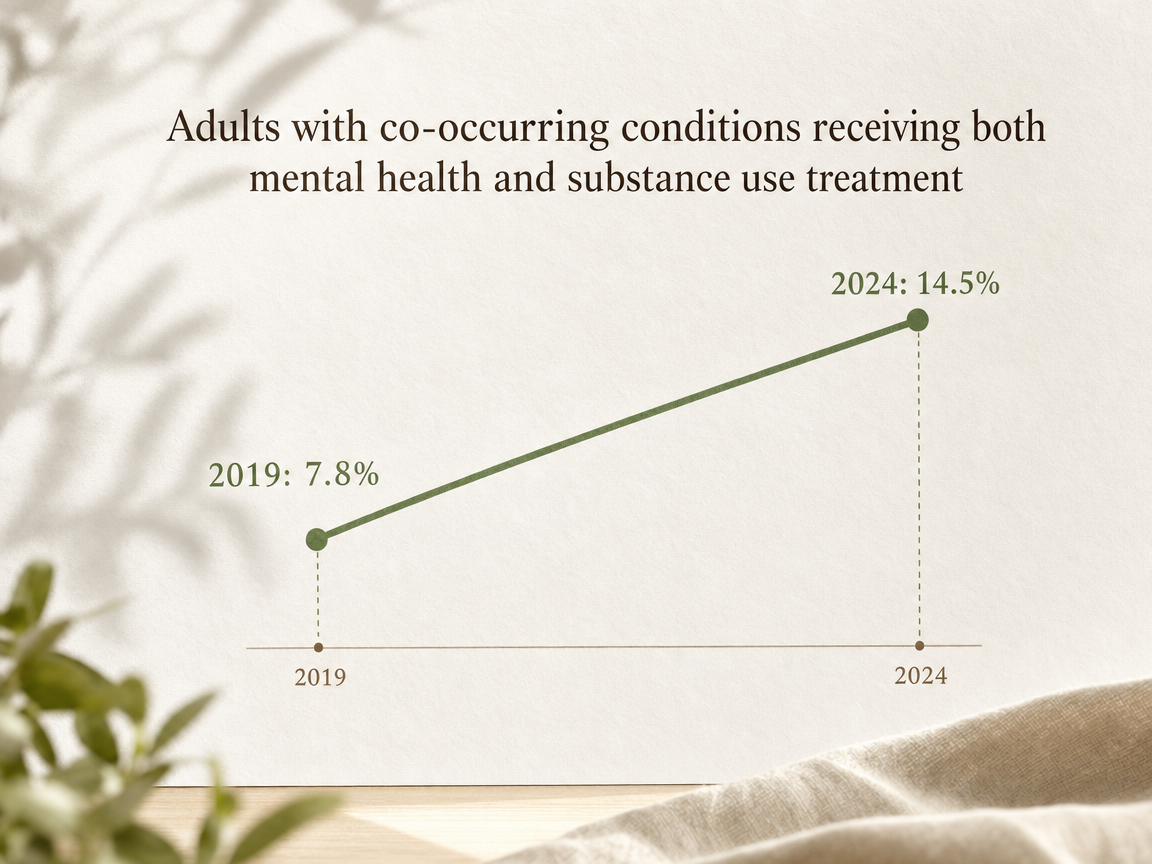
There is good news buried in the federal data, and it is worth naming before the harder part. Between 2019 and 2024, the share of US adults with co-occurring mental health and substance use conditions who received both types of treatment climbed from 7.8% to 14.5% 9. That is nearly a doubling in five years. If you have been doing this work long enough to remember when “integrated care” was mostly a conference slide, that shift is real progress. Someone is answering the phones. Someone is billing both codes. Patients who used to bounce between two systems are, more often than before, being held by one.
Now the harder part. The same number means that about 85% of adults with co-occurring conditions still are not getting both kinds of treatment. Most of your patients, statistically, are walking into a system that will treat one condition and miss the other, or hand them a second appointment they will not keep. The scope matters here: this is US adults, self-reported, national. It is not Atlanta-specific and it does not measure fidelity to integrated care, only whether both service types were received in the past year. The gap on the ground is likely wider than the number suggests.
Why is progress this slow when the evidence has been settled for years? The ASPE adoption analysis is blunt about it. Siloed funding streams, separate licensing pathways for mental health and SUD providers, and reimbursement rules that do not pay cleanly for concurrent sessions all push programs toward co-location instead of true integration 5. In Georgia, layer on the multi-agency approval process that stretches provider enrollment across months 13, and the practical outcome is fewer integrated programs in-network on any given discharge day.
So when your patient does not get a real integrated referral, it is not because you missed something. The system is built to make that referral hard. Knowing which components to insist on, and which access door to knock on first, is how you close the gap one patient at a time.
Mapping the Atlanta access layer: which door opens which service
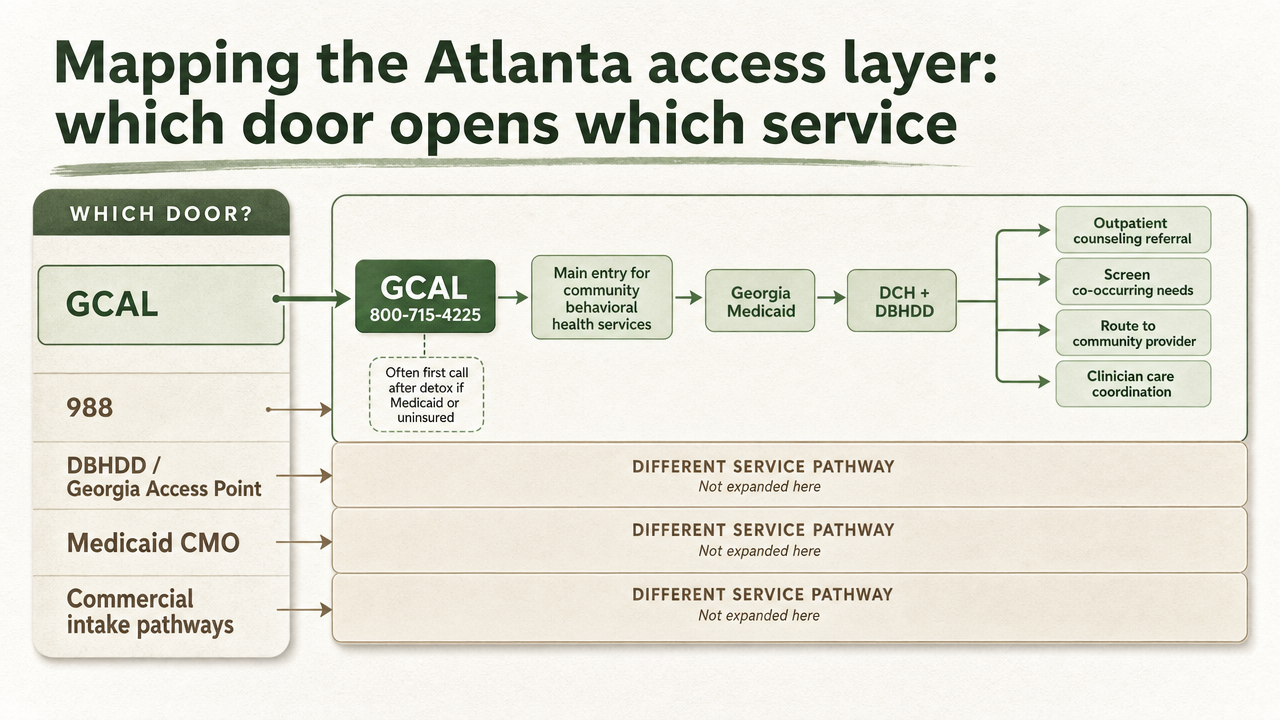
Once you know what integrated counseling should look like, the next question is how a patient in metro Atlanta actually reaches it on Tuesday afternoon. Georgia routes behavioral health access through a handful of specific doors, and each one opens a different service. Calling the wrong one costs you days you do not have.
Start with the Georgia Crisis and Access Line at 800-715-4225. This is the main entry point for community behavioral health services under Georgia Medicaid, run through DCH’s partnership with DBHDD 12. For a patient leaving detox with Medicaid or without insurance, GCAL is usually your first call for an outpatient counseling referral, and the intake staff can screen for co-occurring needs and route to a community provider. It is also the line the state expects clinicians to use for care coordination questions.
988 is the crisis line, not the access line. Use it when a patient is in active suicidal, homicidal, or acute behavioral crisis and needs immediate stabilization support 3. DBHDD lists 988 alongside its dual diagnosis resources because crisis contact is part of continuing care, but 988 is not going to place your patient into a Tuesday counseling slot. Keep the two numbers separate in your discharge script.
DBHDD’s regional coordination sits behind both lines and shapes which programs are funded to serve which populations. Remember the terminology point from earlier: if you are navigating DBHDD-branded “dual diagnosis” resources, you are inside the mental illness plus IDD service line, reached through the Georgia Access Point 2. For MH plus SUD, stay in the GCAL and Medicaid CMO lane.
For Medicaid patients, the Care Management Organization determines which network your patient’s counseling has to fall inside 12. Verify the CMO before the referral, not after. For commercially insured patients, you are back to standard network verification and prior authorization, which sits outside the state-run pathways entirely.
Building the counseling curriculum: CBT, RPT, and dual recovery groups
Once a patient lands in a counseling program, the question shifts from access to what happens in the therapy hour. For dual diagnosis work, the curriculum has to hold both conditions at the same time, in the same room, with modalities that were built for that job.
Cognitive-behavioral therapy is the workhorse, but the version that matters for co-occurring care is integrated CBT with relapse prevention therapy layered in. SAMHSA’s guide on cognitive-behavioral approaches describes RPT as a way to run functional analysis across substance use and mental health symptoms together, then build coping skills tailored to the high-risk patterns that actually show up in the patient’s week 10. That is different from a program running a generic CBT depression protocol on Tuesday and a generic relapse prevention worksheet on Thursday. In an integrated session, the clinician traces how a Sunday-night anxiety spike led to a drink, then a missed medication dose, then two days of low mood — and works the coping skills for each link in that chain in one conversation.
Dual recovery groups are the other piece worth insisting on. SAMHSA’s Treatment Improvement Protocol chapter lists dual recovery groups alongside integrated screening and motivational interventions as core components of an integrated setting 8. These are not generic 12-step meetings and not standard process groups. They are curated around members who are working both conditions, so the person managing bipolar disorder and alcohol use disorder is not the only one in the room translating between two vocabularies.
Stage-wise sequencing runs underneath all of it. A patient in early engagement needs motivational work and psychoeducation, not a full skills-building load. As readiness grows, the same curriculum layers in active coping practice, then relapse prevention rehearsal, then maintenance. When you are vetting a program’s curriculum, ask which modalities live at which stage. If the answer is the same worksheet for everyone in week one, the curriculum is not stage-matched, and your patient’s earliest sessions will land wrong.
The schizophrenia-spectrum plus SUD subgroup
Patients with schizophrenia-spectrum disorders and co-occurring substance use need their own clinical playbook, and the general dual diagnosis literature rarely gives it enough room. If this is a slice of your caseload, the standard integrated approach still applies, but the mechanics change in specific ways worth flagging.
Engagement is slower. A patient managing psychotic symptoms and active alcohol or stimulant use often cannot tolerate a full-intensity outpatient schedule in the first weeks after detox. The peer-reviewed guidance on this population points to comprehensive assessment, continuous monitoring, and coordinated care as the operating stance, with integrated psychosocial and pharmacologic treatment layered in as tolerance builds 11. Translated into your handoff: expect longer engagement stages, shorter session lengths early on, and case management that does not disappear between appointments.
Medication management gets more complex. You are coordinating antipsychotics with any SUD pharmacotherapy, watching for interactions, and staying alert to misuse risk with any controlled agent. That is a shared job between the prescribing psychiatric NP or MD, the counseling clinician, and whoever is doing the weekly check-ins. It falls apart when any one of those roles is vacant on a given week.
When you refer this subgroup, ask the counseling program two specific questions: how do you keep patients engaged through psychotic symptom fluctuations, and who owns medication monitoring across the SUD and psychiatric prescriptions. If the answers are vague, keep looking. This population does not survive a fragmented handoff, and the evidence for integrated treatment as the standard for them is strong 11.
If you manage multiple sites or a referral network: operational access levers
A quick audience note: this section shifts from the individual clinician planning one handoff to those of you running a referral network, a multi-site clinical operation, or a health-system service line where dozens of dual diagnosis discharges route through your team each month. The levers change at that scale.
At one patient at a time, network friction is a nuisance you work around. At fifty patients a month, it is a throughput problem you have to design against. The supplied research does not include Atlanta-specific pricing or reimbursement rates, so what follows is an operational-constraint view — the non-dollar levers you actually control when routing volume through Georgia’s system.
| Access pathway | Typical use case | Known friction ||—|—|—|| GCAL 800-715-4225 | Medicaid or uninsured patients needing community behavioral health intake and co-occurring screening 12| Depends on which community providers currently hold contracts and open slots in your CMO’s network || 988 | Active behavioral crisis, suicidal or homicidal ideation, acute decompensation 3| Not a scheduling line; stabilizes but does not place into ongoing counseling || DBHDD regional coordination | Patients whose co-occurring picture includes intellectual or developmental disability, routed through the Georgia Access Point 2| Wrong door for MH+SUD referrals; misrouting here costs days || Georgia Medicaid CMO direct | Verifying network status and prior authorization for a specific counseling program 12| Provider enrollment across up to three state entities can run two to nine months, so in-network lists shift quarter to quarter 13|| Private commercial intake | Commercially insured patients | Standard network verification and prior auth; sits outside state-run pathways |
Three levers worth building into your standing operations:
- Maintain a live in-network counseling roster per CMO and refresh it monthly, not quarterly. Given the enrollment timeline documented in the state audit 13, a program that was in-network in January may not be by April, and the reverse is also true.
- Script your discharge planners to name the specific co-occurring diagnoses on every referral rather than using “dual diagnosis” as shorthand, since the DBHDD terminology split 2misroutes at scale exactly the way it misroutes one patient.
- Track which counseling programs actually take your warm handoffs and hold patients past the first two appointments. That data lives in your discharge logs already; someone just has to pull it. The programs that keep patients engaged are the ones worth prioritizing in your referral rotation, network status permitting.
Vetting a counseling program’s fidelity to integrated care
You already know the polished intake pitch. Every program says integrated. The question is what you ask next.
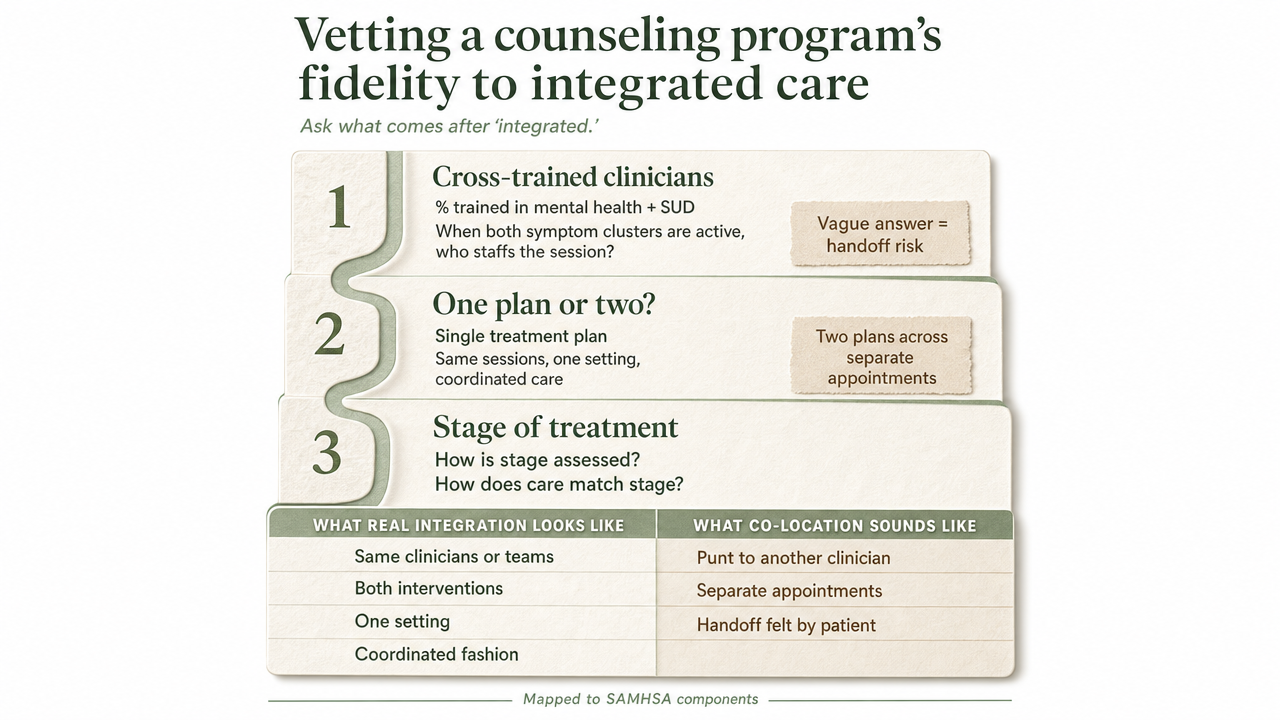
Here is a short list of questions that separate real integration from co-location, all mapped to the SAMHSA components you can hold them against:
- What percentage of your clinicians are cross-trained in both mental health and SUD, and how do you staff a session when both symptom clusters are active? A vague answer means one clinician will punt to another, and your patient will feel the handoff 9.
- Are the mental health and SUD treatment plans a single document worked in the same sessions, or two plans coordinated across separate appointments? Integrated treatment is defined as the same clinicians or teams providing both interventions in one setting, in a coordinated fashion 6.
- How do you assess stage of treatment at intake, and how does that change what happens in weeks one, four, and twelve? If the answer is a fixed curriculum for everyone, stage-wise care is aspirational, not operational 7.
- Do you run dual recovery groups, and how are they facilitated differently from a standard process group or a 12-step meeting 8?
- Who monitors pharmacotherapy across psychiatric and SUD medications, and how often does that clinician talk to the counselor? Name a person and a cadence.
- What is your engagement rate at 30, 60, and 90 days for co-occurring patients? Programs that measure this will have a number ready. Programs that do not are guessing.
One last check that costs nothing. Send a warm handoff and watch what happens in the first two weeks. Does someone call your patient before the first appointment, or does the patient have to make the first move? Programs that reach out are practicing assertive engagement. That is the tell.
Closing the loop from detox to sustained counseling
The handoff you engineer this week is the one your patient will remember. Not the diagnostic clarity, not the medication list, not the group they attended on day four. What sticks is whether someone was waiting on the other side of the door.
A few things to carry forward. Name the co-occurring conditions specifically on every referral, not “dual diagnosis” as shorthand, so intake staff route to the MH+SUD service line and not the DBHDD IDD line 2. Verify CMO network status the day of discharge, not the week before, because Georgia’s provider enrollment timeline keeps in-network rosters shifting 13. Ask the receiving program the specific questions about concurrent sessions, cross-training, and stage of treatment that separate integrated care from co-location 9.
The federal picture is moving in the right direction, and the daily reality still leaves most co-occurring adults short of integrated care. Your handoff is where that gap narrows or widens for one person at a time. When you need a stabilization partner who treats detox as the first hour of counseling rather than the last hour of medical care, Sunrise Detox is built for that link.
Frequently Asked Questions
Does ‘dual diagnosis’ mean the same thing in Georgia’s DBHDD system as it does clinically?
No, and this trips up referrals often. DBHDD uses ‘dual diagnosis’ to mean co-occurring mental illness and an intellectual or developmental disability 2. Clinically, most of you mean mental illness plus SUD. Name the specific diagnoses on every referral rather than using the shorthand, so intake staff route your patient to the right service line.
What’s the fastest way to connect an Atlanta patient to community behavioral health services after detox?
For Medicaid or uninsured patients, call the Georgia Crisis and Access Line at 800-715-4225. GCAL is the main entry point for community behavioral health under DCH’s partnership with DBHDD, and staff can screen for co-occurring needs and route to a community provider 12. Verify the patient’s Care Management Organization first so the referral stays in-network.
How long does Medicaid provider enrollment actually take in Georgia, and how should that shape referrals?
Georgia’s provider enrollment can take two to nine months across up to three state entities 13. In-network rosters shift quarter to quarter as a result. Refresh your counseling roster monthly rather than quarterly, and verify network status the day of discharge, not the week before. A strong clinical program may still be locked out of your patient’s plan for reasons unrelated to quality.
What should you look for to confirm a counseling program truly delivers integrated care?
Ask whether mental health and SUD are on one plan worked in the same sessions by the same team, not two plans coordinated across appointments 6. Confirm cross-trained clinicians, stage-wise care matched to readiness, dual recovery groups, and a named person monitoring pharmacotherapy across psychiatric and SUD medications 9. Programs that measure 30, 60, and 90-day engagement rates have a number ready.
How do you handle counseling for patients with schizophrenia-spectrum disorders and co-occurring SUD?
Expect slower engagement, shorter early sessions, and case management that holds between appointments. Comprehensive assessment, continuous monitoring, and coordinated psychosocial plus pharmacologic care are the operating stance for this population 11. When referring, ask specifically how the program keeps patients engaged through psychotic symptom fluctuations and who owns medication monitoring across antipsychotics and SUD pharmacotherapy. Vague answers here mean fragmented care your patient will not survive.
When should you use 988 versus GCAL for an Atlanta patient in crisis?
Use 988 for active suicidal, homicidal, or acute behavioral crisis needing immediate stabilization support 3. Use GCAL at 800-715-4225 when the patient needs to be routed into ongoing community behavioral health services and outpatient counseling 12. 988 stabilizes; it does not book a Tuesday counseling slot. Keep both numbers separate in your discharge script so staff make the right call under pressure.
References
- Dual Diagnosis Services | Georgia Department of Behavioral Health and Developmental Disabilities. https://dbhdd.georgia.gov/dual-diagnosis-services-list
- Understanding Dual Diagnosis | Georgia Department of Behavioral Health and Developmental Disabilities. https://dbhdd.georgia.gov/filling-gap-georgia-access-point/understanding-dual-diagnosis
- Additional Resources | Georgia Department of Behavioral Health and Developmental Disabilities. https://dbhdd.georgia.gov/additional-resources-dual-diagnosis
- Finding Help for Co-Occurring Substance Use and Mental Disorders. https://www.nimh.nih.gov/health/topics/substance-use-and-mental-health
- Adoption of Integrated Care for People with Co-Occurring Mental Health and Substance Use Conditions. https://aspe.hhs.gov/sites/default/files/documents/e2ccdd7991f1de5060983598cb66624f/adoption-integrated-care.pdf
- Integrated Treatment for Co-Occurring Disorders: The Evidence. https://library.samhsa.gov/sites/default/files/ebp-kit-the-evidence-10242019.pdf
- Integrated Treatment for Co-Occurring Disorders: Building Your Program. https://library.samhsa.gov/sites/default/files/ebp-kit-building-your-program-10112019.pdf
- Chapter 7—Treatment Models and Settings for People With Co-Occurring Disorders. https://www.ncbi.nlm.nih.gov/books/NBK571024/
- Substance Use Disorder Treatment for People with Co-Occurring Disorders. https://library.samhsa.gov/sites/default/files/pep20-06-04-006.pdf
- Integrated Co-Occurring Treatment Using Cognitive-Behavioral Approaches. https://library.samhsa.gov/sites/default/files/SAMHSA_Digital_Download/PEP20-02-01_004.pdf
- Improving the Care of Individuals with Schizophrenia and Substance Use Disorders. https://pmc.ncbi.nlm.nih.gov/articles/PMC2599914/
- Behavioral Health Services – Georgia Medicaid. https://medicaid.georgia.gov/types-services/behavioral-health-services
- Behavioral Health Services for the Medicaid Population – Georgia State Audit Report. https://open.ga.gov/openga/report/downloadFile?rid=25558


