

Key Takeaways
- Searching for a psychologist in Fort Lauderdale often signals a co-occurring mental-health and substance-use picture, which the CDC estimates affected 21.2 million U.S. adults in 2024 1.
- Broward County’s overdose landscape — 422 fatal overdoses in 2024 and 1,511 EMS naloxone administrations in 2025 9— makes sequencing care and medical stabilization matter as much as clinician choice.
- Before booking, compare how a psychologist screens for substance use, which prescribers and detox facilities they coordinate with, and whether integrated care follows SAMHSA and AHRQ definitions 10, 8.
- Weigh coverage, language match, and continuing-care planning alongside therapy approach, since evidence supports coordinated CBT and motivational interviewing but no single modality resolves both conditions alone 6, 12.
When a Therapist Search Is Really a Dual-Diagnosis Search
You typed “psychologist Fort Lauderdale” into a search bar, but the reason you did it is probably more complicated than the query suggests. Maybe the anxiety has stopped responding to the two glasses of wine that used to quiet it. Maybe a family member’s Xanax use has crossed a line neither of you can name. Maybe there’s a PTSD diagnosis on paper and a stimulant habit that nobody’s written down yet. You’re not shopping for a therapist the way you’d shop for a dentist. You’re trying to figure out what kind of help actually fits what’s happening.
That instinct is worth trusting. Mental-health conditions and substance-use disorders overlap far more often than the separate specialties suggest, and the CDC estimates that roughly 21.2 million U.S. adults had both a mental-health condition and a substance-use disorder in 2024 1. In Broward County, that overlap plays out against a real backdrop of overdose calls, ER visits, and family members who have already tried the single-provider route.
Here’s the honest version: a psychologist in Fort Lauderdale can be central to your recovery, but rarely as a solo act. When withdrawal risk, unstable psychiatric symptoms, or recent overdose are part of the picture, therapy fits into a sequence — medical stabilization, coordinated assessment, integrated treatment, and continuing care. This article walks you through that sequence so you can locate yourself in it, ask better questions, and stop feeling like you’re guessing at which door to open first.
Why Psychology Alone Rarely Fits Co-Occurring Disorders
The Missed Connection Between Treatment and Overdose
There’s a pattern in the overdose data that should change how you think about scheduling a first therapy appointment. Looking at people who died from overdose in 2024, the CDC found that:
- 37% had evidence of a mental-health diagnosis
- 32% had ever been treated for a mental-health or substance-use disorder
- 20% were in current treatment at the time of death 2
One in five was actively in someone’s care when they died.
That isn’t a story about treatment failing. It’s a story about treatment happening in pieces. A therapist working the depression without visibility into the fentanyl. A prescriber managing the anxiety without knowing about the nightly drinking. A detox stay that ended without a warm handoff to anyone who could keep the psychiatric symptoms from unraveling in week two.
So the question isn’t only whether a psychologist is competent. It’s whether the psychologist is set up to be one part of a plan that also accounts for withdrawal risk, medication needs, and what happens between sessions when things get worse.
What Screening Should Actually Catch at Intake
A first appointment with a psychologist is supposed to do more than confirm what you already suspect about your mood. When substance use is anywhere in your recent history, the intake should screen for both sides of the picture at once — not as a checklist tacked on at the end, but as the frame for the whole conversation.
The CDC defines co-occurring hospital encounters as those involving both a substance-use diagnosis and selected mental-health conditions, including anxiety, trauma-related disorders, depression, and self-harm thoughts or behaviors 3. That definition exists because emergency clinicians learned the hard way that assessing one without the other misses the actual risk in front of them. The same logic applies in an outpatient office in Fort Lauderdale. If the intake asks carefully about panic attacks but never asks how much you drank last night, or catalogs your medications without asking about kratom, cocaine, or leftover Percocet, that’s not a dual-diagnosis assessment.
A good intake will ask about:
- Withdrawal history
- Prior detox admissions
- Overdose events
- Current use patterns
- Any recent changes in tolerance
Alongside the trauma history, mood symptoms, sleep, and suicidal thinking. The goal isn’t to catch you in something. It’s to figure out whether you can safely start outpatient work this week, or whether medical stabilization needs to come first so the therapy actually has ground to stand on.
Broward County’s Substance-Use Landscape and Why Sequencing Matters
Fort Lauderdale sits inside a county that has been living with a substance-use emergency for years, and the numbers explain why a first-appointment decision here carries more weight than it might in a quieter place. The Florida Department of Health’s dashboard for Broward County recorded:
- 422 fatal overdoses in 2024
- 4,179 EMS overdose responses in 2025
- 1,511 naloxone administrations by EMS in 2025
- 3,886 drug arrests in 2025 9
Those are your neighbors. Some of them were already in treatment somewhere. Many were not.
What this landscape means for you, practically, is that the risk window around active use in Broward is not theoretical. Fentanyl contamination shows up in supplies that people believed were something else. Benzodiazepine and alcohol withdrawal can turn medically dangerous within a day or two of trying to stop on your own. If you are searching for a psychologist while any of that is in play — for yourself or someone you love — the sequence of care matters as much as the quality of any single provider on the list.
Sequencing is a plain idea. It means matching the intensity of help to where the body and mind actually are right now. Weekly outpatient therapy is a powerful tool for someone who is medically stable, sleeping, and not in acute withdrawal. It is the wrong first step for someone who needs a monitored taper off Xanax, or who used fentanyl three days ago and has been to the ER twice this year. In those situations, medical stabilization comes first — not because therapy doesn’t matter, but because therapy needs a stable person to work with.
This is where a Fort Lauderdale psychologist becomes useful in a different way than the search bar implies. The right clinician will know the local detox and crisis options, understand which questions to ask before the first session even starts, and be honest with you if what you actually need this week is a medical bed rather than a therapy hour. That kind of triage is not a rejection. It is what integrated care looks like when someone is paying attention.
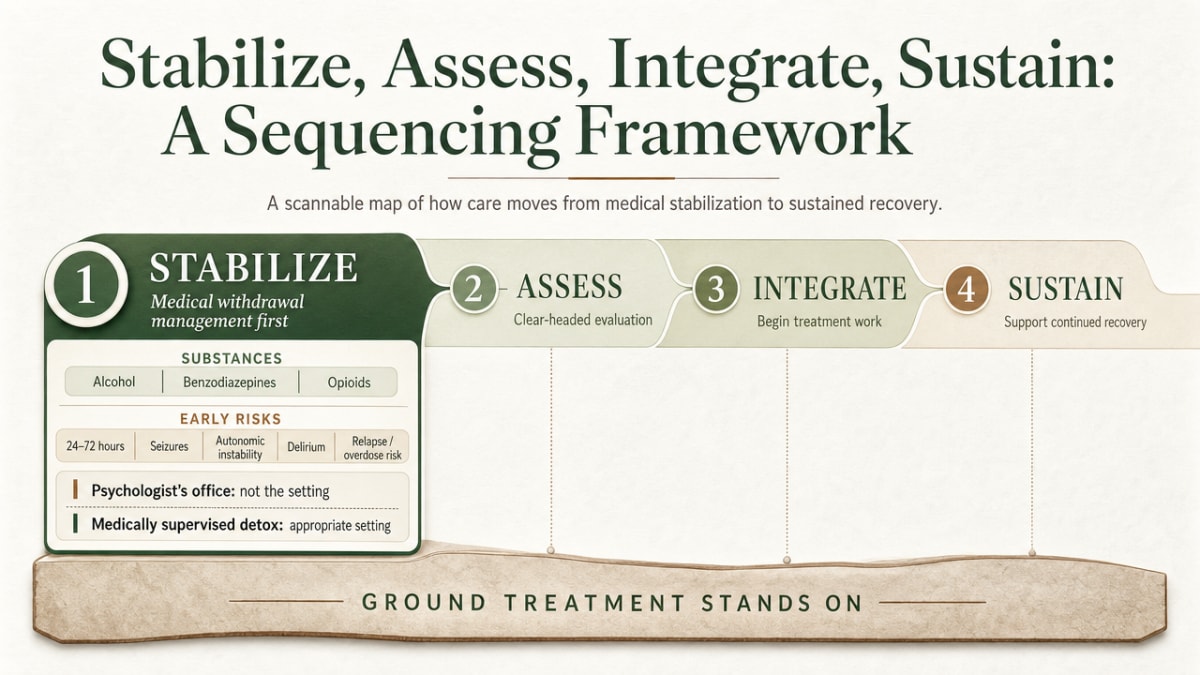
Stabilize, Assess, Integrate, Sustain: A Sequencing Framework
Stabilize: When Medical Withdrawal Management Comes First
Stabilization is the part of the plan that keeps you alive and clear-headed enough to do the rest of the work. It’s not the whole treatment. It’s the ground the treatment stands on.
Certain substances make stabilization non-negotiable. Alcohol and benzodiazepines — Xanax, Klonopin, Ativan, Valium — can produce withdrawal that turns medically serious within 24 to 72 hours: seizures, autonomic instability, delirium. Opioid withdrawal from heroin, fentanyl, or prescription pills is rarely fatal on its own, but the relapse-and-overdose risk during and just after withdrawal is high, particularly given fentanyl’s presence in Broward County’s supply. A psychologist’s office is not the setting for any of that. A medically supervised detox is.
How do you know if this is you? A few honest questions help:
- When you’ve tried to stop or cut down, did you have tremors, sweats, racing heart, seizures, or hallucinations?
- Are you drinking daily to prevent shakes in the morning?
- Has your benzodiazepine dose been climbing, or are you running out early?
- Did you use opioids in the last week, and has your tolerance dropped from a break or a jail stay?
If any answer is yes, the first call is to a medical provider or a detox facility, not a therapist.
Stabilization doesn’t erase the psychiatric picture — anxiety, PTSD, depression, and bipolar symptoms often intensify during withdrawal. It does buy you a body and brain that can start participating in the assessment that comes next.
Assess: What a Thorough Dual-Diagnosis Evaluation Includes
Assessment is the step where the plan actually gets built. Done well, it takes more than one 50-minute hour and involves more than one clinician looking at you.
A thorough dual-diagnosis evaluation covers both sides of the picture at the same depth:
- On the substance side: current use, route, quantity, frequency, last use, withdrawal history, prior detox admissions, overdose events, medication-assisted treatment history, and what has and hasn’t worked before.
- On the psychiatric side: mood, anxiety, trauma, psychotic symptoms, sleep, suicidal thinking, prior diagnoses, prior medications, and family history.
- Context that clinicians sometimes skip: housing, work, legal issues, immigration status, language preference, custody or family pressures, and who at home is safe to involve.
In Fort Lauderdale, where a significant share of residents speak a language other than English at home, whether the evaluation happens in your first language matters for accuracy, not just comfort.
What you should walk away with is a working formulation — what’s driving what, what needs to be treated first, and who does which part.
Integrate: The Team Around a Fort Lauderdale Psychologist
Integration is where the word “team” starts meaning something specific. A psychologist is one seat at the table. The rest of the seats matter just as much.
SAMHSA’s Treatment Improvement Protocol 42 frames integrated care as concurrent, coordinated treatment of substance-use and mental disorders, delivered by trained providers using stage-matched interventions, psychotherapy, family and peer support, and medication management 10. AHRQ describes integration in similar terms: a practice team of medical and behavioral-health clinicians working with patients and families through a systematic, patient-centered approach 8. Neither definition places one profession at the center. Both describe a group that talks to each other.
In practice, the team around a Fort Lauderdale psychologist usually includes:
- A prescriber — a psychiatrist, psychiatric nurse practitioner, or addiction-medicine physician — who handles psychiatric medications and, when appropriate, medications for opioid or alcohol use disorder.
- A medical detox facility that handles acute withdrawal when it’s needed.
- A care coordinator or case manager who tracks the moving pieces: appointments, referrals, prior authorizations, transportation.
- Peer support specialists — people in recovery themselves — who often carry the parts of the day the clinical team can’t.
- Family members, when it’s safe to involve them.
The integration question you can ask any Fort Lauderdale psychologist directly: who else will be on my care team, and how will you communicate with them? A vague answer is a signal. A concrete one — names of prescribers they work with, a signed release, a plan for warm handoffs — is what integrated care actually looks like on the ground.
Sustain: Continuing Care After the Acute Phase
The stretch after the acute phase is where a lot of well-started plans quietly come apart. Detox ends. The intensive outpatient program tapers. The psychiatric symptoms are quieter but not gone. And the calendar in front of you looks a lot like the one you had before.
Sustaining care means the treatment plan keeps existing when nothing is on fire. That usually looks like:
- Ongoing individual therapy at a cadence that matches your stability
- Continued medication management
- Involvement with a peer or mutual-support community
- A plan you and your team have rehearsed for what to do if things start slipping
NIDA notes that for opioid- and alcohol-use disorders, medications are effective and often belong in the long-term picture alongside psychosocial care 11.
A Fort Lauderdale psychologist worth their license will treat continuing care as part of the initial plan, not an afterthought. That means naming, at intake, what the six-month and twelve-month picture might look like — including who reassesses when symptoms shift, and what triggers a step back up to a higher level of care without it feeling like failure. Sustained recovery is boring in the good way. Build for it early.
What the Evidence Actually Says About Therapy for Dual Diagnosis
You deserve a straight answer about what therapy can and can’t do here, because the marketing around dual-diagnosis treatment tends to promise more than the studies support.
The overall direction of the research is genuinely encouraging. A 2025 umbrella review of 28 systematic reviews found that coordinated or integrated treatment generally outperformed treating only one condition alone, and usually outperformed uncoordinated parallel services where different providers work on different problems without talking to each other 13. A separate umbrella review reached similar conclusions and noted substantial heterogeneity across studies 4. In plainer terms: when the people treating your addiction and the people treating your mental health are on the same team, outcomes tend to be better than when they’re not.
Now the honest part. For anxiety paired with substance use, a 2024 systematic review and meta-analysis found small-to-moderate effects for anxiety, alcohol, and other substance outcomes, with larger effects for depression — but the authors flagged high heterogeneity as a limit on how confidently any of it can be generalized 5. And CBT, the therapy most often named as the default for dual diagnosis, has a more mixed record than its reputation suggests. A recent review of 23 studies found that CBT-based interventions helped some mental-health or substance-use symptoms, but several did not clearly outperform standard addiction treatment 6.
What this means for your first appointment: a Fort Lauderdale psychologist offering CBT, motivational interviewing, or contingency management — the modalities NIMH names as evidence-informed for co-occurring conditions 12— is on solid ground. A clinician promising that one specific therapy will fix both sides of your diagnosis is overselling. Ask which approaches they use, why those fit your situation, and how they’ll know within a few weeks whether the plan is working or needs to change.
What a Good Intake Conversation With a Fort Lauderdale Psychologist Sounds Like
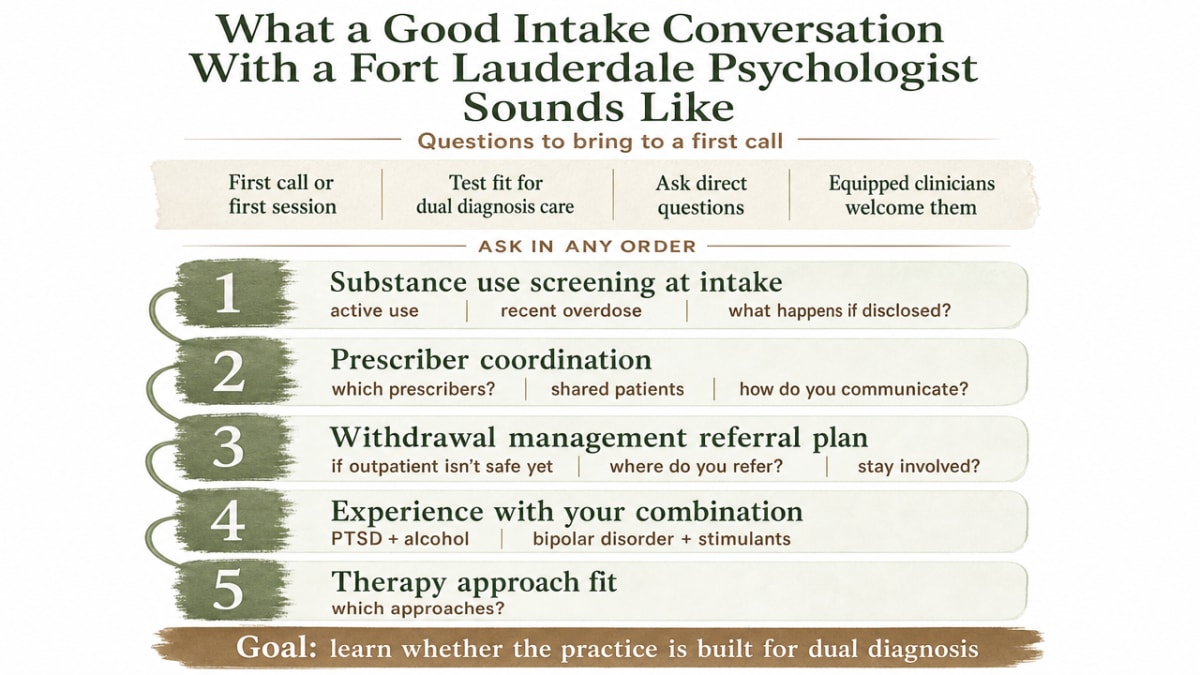
The first phone call or first session is a chance to test whether a practice is actually built for dual diagnosis or just willing to take the appointment. You are allowed to ask direct questions. A clinician who is genuinely equipped will welcome them.
Try these, in whatever order feels natural:
- How do you screen for substance use at intake, and what happens if I disclose active use or recent overdose?
- Which prescribers do you work with regularly, and how do you communicate with them about shared patients?
- If I need medically supervised withdrawal management before outpatient therapy is safe, where do you refer, and will you stay involved during that stretch?
- What is your experience with the specific combination I’m dealing with — say, PTSD and alcohol, or bipolar disorder and stimulants?
- Which therapy approaches do you use, and how will we know in four to six weeks whether they’re helping?
Listen for specifics. A clinician who names actual detox facilities, psychiatrists, and care coordinators they collaborate with, and who can describe how releases and handoffs work, is describing integrated care the way SAMHSA and AHRQ define it — concurrent treatment by a coordinated team 10, 7. A clinician who says some version of “I just focus on the therapy piece” is telling you something honest and important: you’ll need to build the rest of the team yourself, or find a different starting point.
Coverage, Language, and the Florida Integration Mandate
The practical barriers to getting integrated care in Fort Lauderdale usually aren’t clinical. They’re the ones the search results don’t show you: what your insurance actually covers, whether there’s a clinician who speaks your language, and whether anyone will do the work of coordinating across the system so you don’t have to.
On coverage, the honest answer is that dual-diagnosis care in Broward touches Medicaid, Medicare, commercial plans, and self-pay in different combinations depending on the provider. Ask any Fort Lauderdale psychologist directly whether they accept your plan for both diagnostic and ongoing sessions, whether prior authorization is needed, and what happens if you need a higher level of care mid-treatment. If cost is a barrier, community mental-health centers and federally qualified health centers in Broward serve people on sliding scales and Medicaid — those are legitimate front doors, not consolation prizes.
On language, ask before you book. A Spanish- or Creole-speaking clinician, or a practice with trained medical interpreters, changes what an intake can actually surface. Nuance in a trauma history or a use pattern rarely survives a language mismatch.
On coordination, Florida Statute 394.66 requires the state behavioral-health system to integrate services for people with co-occurring mental illness and substance-abuse problems across treatment systems 14. That mandate doesn’t guarantee a smooth handoff on any given Tuesday, but it does give you standing to expect one — and language to use when a provider says coordination isn’t their job.
When to Call a Crisis Line Instead of Booking a Therapist
Dial or text 988 for the Suicide and Crisis Lifeline. Call 911 or go to the nearest emergency department for overdose, chest pain, seizures, or any acute medical emergency. NIDA points people in crisis to 988, emergency services, and FindTreatment.gov as the immediate front doors before scheduled outpatient care 11. In Broward County, EMS administered naloxone 1,511 times in 2025 9— that resource exists for exactly these moments.
Calling for emergency help doesn’t cancel the plan to see a psychologist. It’s the step that makes the plan possible. Sunrise Detox and other medical facilities in the area can take the handoff from an ER and begin stabilization the same day.
Frequently Asked Questions
Do I need a psychologist or a psychiatrist for co-occurring anxiety and alcohol use?
Often you need both, working together. A psychologist provides therapy — CBT, motivational interviewing, or trauma-focused work — while a psychiatrist or addiction-medicine prescriber handles medications for anxiety and, when appropriate, alcohol-use disorder. NIMH describes integrated care as combining these pieces in one coordinated plan rather than picking one profession 12. Ask whether the psychologist already collaborates with a prescriber.
Is it safe to start outpatient therapy in Fort Lauderdale while I’m still drinking or using?
Sometimes yes, sometimes no. If you have daily alcohol or benzodiazepine use, tremors when you stop, recent overdose, or unstable psychiatric symptoms, medical stabilization comes first — outpatient therapy can’t manage acute withdrawal. If use is lower-risk and you’re medically stable, therapy can start alongside a coordinated plan. A good intake will screen both sides of the picture before deciding 3.
What should a dual-diagnosis intake with a Fort Lauderdale psychologist actually include?
Both sides, at the same depth. On substance use: current pattern, last use, withdrawal history, prior detox, overdose events, and medication-assisted treatment history. On mental health: mood, anxiety, trauma, sleep, suicidal thinking, prior diagnoses and medications. It should also cover housing, language, family safety, and legal issues. SAMHSA’s TIP 42 principles call for concurrent assessment of both conditions, not a checklist afterthought 10.
Will a psychologist coordinate with medical detox, psychiatry, and continuing care?
A well-equipped one will. AHRQ defines integrated care as a practice team of medical and behavioral-health clinicians working together with patients and families 8, and Florida Statute 394.66 requires integration across treatment systems for co-occurring disorders 14. Ask directly: which prescribers and detox facilities do you work with, how do you handle releases, and will you stay involved during a higher level of care?
What if I’m uninsured or need Spanish-speaking care in Broward County?
Community mental-health centers and federally qualified health centers in Broward serve people on Medicaid and sliding scales — legitimate front doors, not fallbacks. For language, ask before booking whether a Spanish- or Creole-speaking clinician is available, or whether the practice uses trained medical interpreters. Language match affects what an intake can actually surface, especially around trauma history and use patterns. Coverage details vary by provider.
When should I call a crisis line instead of scheduling a therapy appointment?
Call or text 988 for suicidal thoughts or a mental-health crisis. Call 911 or go to the ER for overdose, seizures, chest pain, severe alcohol or benzodiazepine withdrawal, or any acute medical emergency. NIDA directs people in crisis to 988, emergency services, and FindTreatment.gov as the immediate front doors before scheduled outpatient care 11. Emergency help doesn’t replace therapy — it makes therapy possible.
References
- About Behavioral Health. https://www.cdc.gov/mental-health/about/about-behavioral-health.html
- Substance Use & Mental Health. https://www.cdc.gov/mental-health/about-data/substance-use-mental-health.html
- Drug Use-Associated Hospital Encounters Involving Co-Occurring Disorders. https://www.cdc.gov/nchs/dhcs/drug-use/co-occurring-disorders.htm
- Effectiveness of Psychosocial Interventions for Adults With Substance Use Disorder That Have a Co-Occurring Common Mental Health Disorder: An Umbrella Review. https://pubmed.ncbi.nlm.nih.gov/41192364/
- A Systematic Review and Meta-Analysis of Psychosocial Interventions for Co-Occurring Anxiety and Substance Use Disorders. https://pmc.ncbi.nlm.nih.gov/articles/PMC11347123/
- Cognitive Behavioural Therapy and Dual Diagnosis. https://pubmed.ncbi.nlm.nih.gov/41108580/
- Behavioral Health and Substance Use Disorders. https://www.ahrq.gov/ncepcr/reports/2025-annual-report/behavioral-health.html
- Behavioral Health and Substance Use Disorders. https://www.ahrq.gov/ncepcr/reports/2024-annual-report/recent-grants-behavioral-health.html
- Substance Use Dashboard: Overview. https://www.flhealthcharts.gov/ChartsDashboards/rdPage.aspx?islCounty=6&rdReport=SubstanceUse.Overview
- Substance Use Disorder Treatment for People With Co-Occurring Disorders. https://library.samhsa.gov/sites/default/files/pep20-06-04-006.pdf
- Co-Occurring Disorders and Health Conditions. https://nida.nih.gov/research-topics/co-occurring-disorders-health-conditions
- Finding Help for Co-Occurring Substance Use and Mental Disorders. https://www.nimh.nih.gov/health/topics/substance-use-and-mental-health
- Effectiveness of Psychosocial Interventions for Adults With Substance Use Disorders and Co-Occurring Common Mental Health Disorders: An Umbrella Review. https://pmc.ncbi.nlm.nih.gov/articles/PMC12682421/
- 2025 Statutes 0394.66. https://www.flhouse.gov/Statutes/2025/0394.66/